What is a loop pedal, how do you use it, and which is the best one to buy?
If you’re a solo musician seeking to up the ante in your performances, try some guitar looping for beginners. Use a pedal to create percussion, synths, drums and soundscapes, to accompany your melodies. It’s the modern version of a one-person band.
In this article, we reveal our tips to improve your looping.
Guitar looping for beginners
Guitar loop pedals or “Loopers” allow a singer to record what they are playing. Then, when they kick a pedal, the recording is played back, instantly. This essentially provides a backing track for the singer to record the next line over.
Loop pedals allow you to accompany yourself by recording your guitar and then playing it back. This way you don’t have to sing and play the guitar at the same time. Using a guitar loop pedal in your performance can add layers, dynamics and lots of interest for the audience. You can use it to listen back to your playing and improve. You can create interesting performances with percussive rhythms, bass lines, and chord backing.
What does a guitar loop pedal do?
As early as 1953, musicians were toying with the idea of using music loops live. Les Paul demonstrated live looping on the television show ‘Omnibus’ for the first time that year.
By the early 1990s, when dedicated loop machines first went on sale, the term “live looping” hadn’t yet become a known phrase in the music world.
The first dedicated loop device was the Paradis LOOP Delay. The Paradis and other models didn’t have much memory, so artists had to develop fresh loops live in front of their audiences.
Roland and DigiTech loop pedals entered the market in 2001, around the same time DJ mixing gained popularity.
As laptops gained popularity in 2004, computer software began to emulate the 1990s effects of early looping devices.
What do I need to start looping?
A loop pedal! Prices can range from as cheap as around £50 to as much as £500+, but you’ll get what you pay for. If a pedal is very cheap, it will be restrictive in some way, whether that’s how many tracks you can have or how much memory you can have on each loop.
A good budget to put aside for a starting loop pedal is around £100. The more expensive pedals will have everything you could want from a loop pedal and more. However, they might be too complicated for a learner.
What is the easiest looper to use?
If you want a very basic looper without any effects or memory banks, the Mooer Micro Looper MML1 is the one for you. It’s robust, well-made, and it has a simple design with just one foot-operated button to initiate recording, overdub and stop.
It allows for 30 minutes of recording and unlimited overdubs. There is a clicking noise when engaging the pedal so it’s not suitable for live recording. You can, however, stomp on this unit all day and it won’t break.
TC Electronics offers two options – the DITTO and the DITTO X2. Both have 5 minutes of recording time, which is usually more than enough for the average user. The simplicity of the DITTO makes it very easy to use; it loops, and that is all it does. One input and one output. It follows the current trend of making a pedal as small as possible whilst still being able to deliver what the musician wants. It has a one-foot button and one knob for adjustment in volume.
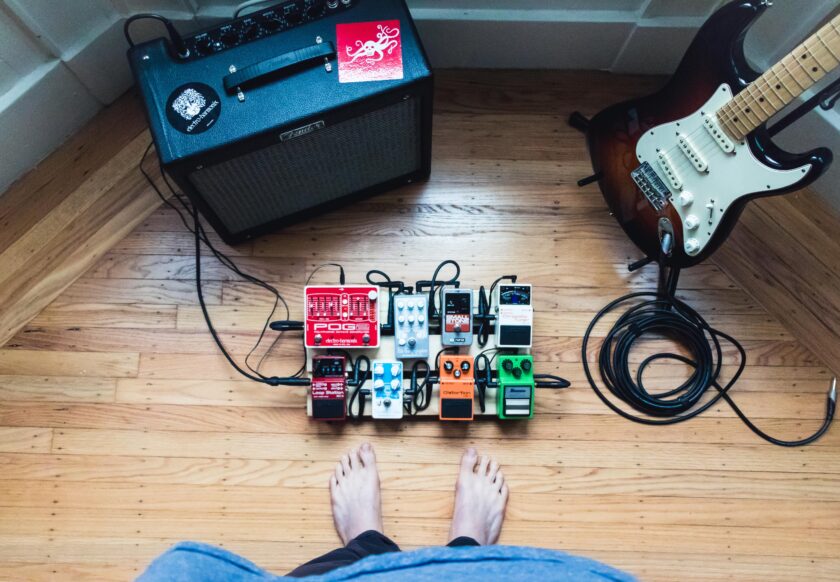
How can I improve my looping?
Be sure to start out at open mic nights or jams. Film your performances, ask for feedback and analyse them. This will ensure you are on point before going to a bigger stage. But before you get anywhere near a live audience, check out these six tips to improve your looping.
#1 Find the best looper pedal for you
Boss offers their busker-friendly looping pedal range in a variety of configurations. From their modest but feature-rich RC-1 to their RC-500.
The Boss RC-1 Loop Station is the simplest of the range and has 12 minutes of stereo recording time. It is designed to be the most user-friendly for those of us who don’t want to read instruction manuals.
The Boss RC-3 Loop Station (which has a massive 3 hours recording time) allows storage of up to 99 loops within its memory bank. It has a “real drums” rhythm guide which can be a useful tool if you are new to looping. It will help you learn when to engage the pedal. With the Boss RC-300 Loop Station, you have complete control over every track you record and every instrument you have plugged in. The input options are vast, including an XLR input with phantom power for microphones, effects and an integrated expression pedal.
#2 Learn how to set up a guitar looper
Recording, overdubbing, playing, and stops aren’t the only things you can do with a loop pedal.
If you have a higher-end pedal, it will provide a wide array of performance-oriented features such as multiple independent loops, quantization, loop multiply, and MIDI integration. Have a play with these and see where your creativity takes you
A great feature of any pedal is when it has more than one input and more than one output; this pedal allows you to send the output signal to multiple amplifiers without the need for a separate splitter. It also allows you to input stereo instruments (like a keyboard or synthesizer). The features can be further extended by adding an optional external footswitch.
#3 Choose good acoustic songs for looping
You can make a loop pedal version of almost anything. It’s all down to your creativity. Some songs may be easier than others though. Here are some songs that lend themselves to being played on loop pedals.
Black Horse and the Cherry Tree
The 1990s saw a boom in the manufacturing of affordable gear and technology for musicians, advancing the loopers prominence. Its potential was showcased when KT Tunstall incorporated it into an early performance of ‘Black Horse and the Cherry Tree’, on Jay Leno in 2006.
She starts using a simple rhythm guitar bed before dressing it up, with the simple tap of a toe, in percussive melody, counter-melodies, and harmonies.
Viva La Vida
By their very nature, loop pedal performances are akin to step-by-step tutorials, as it’s easy to see, in real-time, how each sound is made. This has helped musicians on YouTube get their heads around the tool. In 2008, John Rockcliffe’s cover of Coldplay’s Viva La Vida became one of the first loop pedal covers to gain traction. There have been many loop pedal covers on YouTube similar to this since then.
Shape of You
Nobody has capitalised on the perceived authenticity of the busker-like, one-man-band more than Ed Sheeran. On top of this, nobody has had more success with the loop pedal than the man who rapped the line “watch how I step on the track without a loop pedal” on one of his breakthrough singles, “You Need Me, I Don’t Need You.”
As is typical with Sheeran, “Shape of You” begins with a percussive groove before a melody, guitar strumming, and subtle accents fill out the song.
When he headlined Glastonbury Festival in 2017, he did so with only an acoustic guitar, a keyboard, and a loop station. There was a lot of pressure for him to get this right, to say the least. Just one mistimed toe-tap away from disaster, Sheeran, the master of the pedal, proved that you only need one musician to dazzle a crowd of thousands.
#4 Keep it simple
Too many guitarists make their performances overly complex. If you are taking ages to get the loops built up in the first place, your audience will become disengaged. You must have an engaging performance with a song that works for you. The loop pedal is in no way a substitute for this. It is wise to decide on how many individual loops you want for each track, so all your settings are ready beforehand.
Loop pedals can offer performers endless possibilities for experimentation and are relatively simple to use. And when used correctly, they can be very impressive. But there are also many potential pitfalls to using a guitar loop pedal. This is why the next point is so important.
#5 Practice your loops and settings
If you are considering using the guitar loop pedal for your performance, then you must ensure you have warmed up your guitar, rehearsed and practised a lot. If you play a loop incorrectly it will be out of time for the duration of using that part. And the whole performance will be out of sync. Practising with your pedal will help with your timing, creativity, and desire to play.
Although the small box at your feet opens a lot of opportunities for improvisation during a performance, it is difficult to do. Even the pros rehearse the structure of their track heavily to make sure they get it right.
#6 Try jamming and overdubbing
As you’re learning songs, try looping the riffs and jamming over them. While learning scales and theory, try looping chords in the same key for a melody. You can even loop just one chord by playing a monotonous topline. Keep overdubbing simple licks in the same key to make an intense, complex composition. You can get lost for hours like this playing with a looper. Within a couple of months of doing this repeatedly, your skills will improve drastically.
If you don’t have much of a budget, look out for second-hand models on Gumtree or eBay. Have fun with your loop pedal – you never know where it might take you as a guitarist and recording artist.
Related Questions
What looper does Ed Sheeran use?
While Ed now uses his custom-built looping device – the Chewie Monsta – he began using the Boss RC-20XL, but it’s no longer in production. This pedal has two switches to control two different tracks and a large memory for capturing ever-evolving sounds. It also has a couple of in-built effects to help further colour performance.
Can you use a looper with an acoustic guitar?
Absolutely. Loop pedals tend to be used by acoustic artists. They’re great for a solo musician to fill out the texture of their songs without having additional people playing with them. Loop pedals can also be used discreetly when recording as a band. If you want to create additional parts that you can play with live, a loop pedal is a great option.