Are you planning to buy some studio time, rather than create your own space to produce music?
Not all facilities offer the same level of equipment. It’s important to understand the recording studio essentials you should be looking for when scouting out a place to lay down your tracks. Familiarity with these will also enhance your recording experience.
This article will explain what you need to look for when choosing your venue. And which recording and production gadgets may be useful in getting the exact sound you want.
18 recording studio essentials
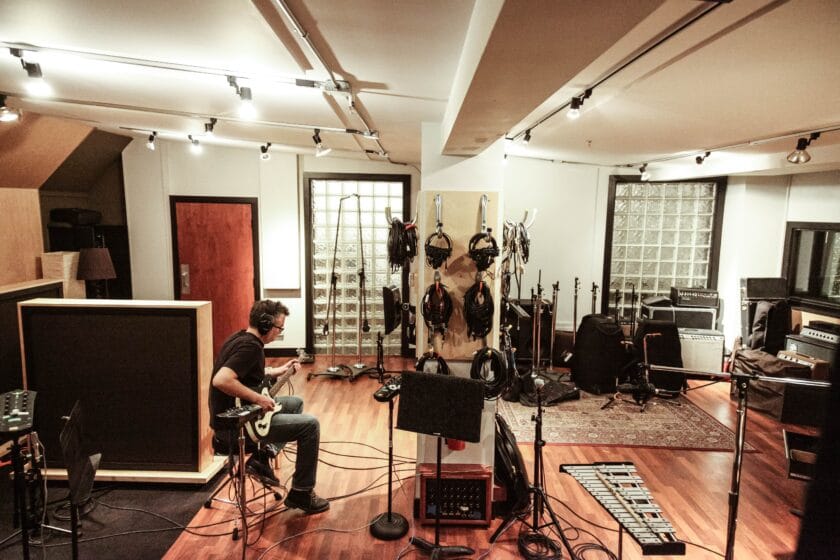
Recording studios come in a variety of shapes and sizes. It may be an amateur booth in somebody’s bedroom, a studio in a garage, or a fully-fledged professional set up with editing, mixing and mastering facilities. The latter is undoubtedly the best option for those seeking a high-quality, commercially ready result. And if you’re considering setting up your own studio, it’s important to understand what’s involved, especially in terms of investment cost. It can be a false economy to buy everything you need when a recording package could end up being cheaper.
Most studios will list what equipment they have on their website. It’s really important to check this, so you can identify whether they’ll be able to provide what you need. But if you don’t understand what any of it does, it won’t prove very helpful. In this article, we’ll explain the basics, so you can understand and recognise the recording studio terminology that’s involved.
Studio equipment – UK
Let’s begin by looking at the 18 essential items required to record music professionally.
- A computer
- A DAW (digital audio workstation -the software used to compose, produce, record, mix and edit audio and MIDI)
- An audio Interface
- Microphones – usually a condenser is best
- Headphones
- Studio Monitors with isolation pads -if you have several you’ll need a controller to manage these.
- Cables (invest in some snake cables)
- Microphone Stands
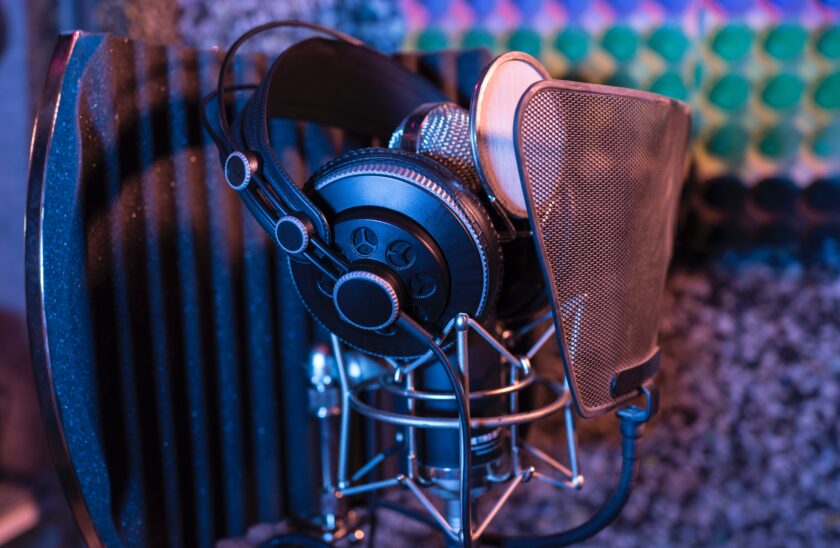
- A pop filter
- Mounts and shock mounts
- Power Conditioner
- Microphone preamp
- Headphone amp
- Monitor and MIDI controllers
- Uninterruptible Power Supply
- Direct Box
- Master Clocks
- Signal booster
Some of these gadgets may be new to you completely. Even if you’ve recorded tracks before, you may not have realised what some of the boxes and wires are. Read on to learn more about the items on this list that are possibly less familiar.
Professional recording studio setup
High quality professional standard equipment is what makes successful music stand out from amateur attempts.
The Daw is a piece of integrated software vital for production. However, it is possible to buy a DAW in device form. These are some of the best DAW software buys to consider if you’re producing your own music.
Avid Pro Tools
Apple Logic Pro X
Ableton Live
Image-Line FL Studio
Cockos Reaper
Reason Studios Reason
Steinberg Cubase
PreSonus Studio One
What equipment do I need to produce music?
The electric currents running through your equipment aren’t smooth. There’ll be spikes and surges, manifesting in musical terms as low-level electrical noise or minor interruptions. If this is something you’ve experienced, then it’s well worth getting a power conditioner to even this out. This is not the same as a surge protector, which prevents dangerous surges in electricity. Power conditioners are purely about sound.
You’ve obviously heard of an amp, but what about a mic preamp? These are necessary when recording vocals. Mics give off a weak signal, so this little gadget is the go-between for your mic and the mixer. It’s less important if you use a condenser, but generally necessary for ribbons and dynamic microphones. You must get a good one – it can transform a poor mic if it’s good, but ruin even a good mic’s sound if it’s not. It’s also worth getting a reflection filter fitted onto your mic.
What equipment do you need to record?
MIDI (Musical Instrument Digital Interface) controllers, on the other hand, sequence music and play virtual instruments on your computer by sending data to the computer or synthesizer. This, in turn, regurgitates the signal and spits out a complete sound. This will, of course, be an important device in building your track, if you’re a vocalist needing virtual backing.
Known as a UPS, an uninterruptible power supply is by no means exclusive to the recording studio. They’re used anywhere you need a constant supply of energy in the event of a power failure. This is vital in a professional studio, as any interruptions could ruin that perfect take and lose everything you’ve done so far. And when musicians are paying by the hour, they don’t want to be delayed or have to repeat sections, because your kit wasn’t up to scratch. A power conditioner purely irons out the current, but can’t protect your supply in the event of a mains fail, so you should have both of these gadgets.
Recording studio equipment list
While we’re on the topic of amps, we should mention the headphone amp. This translates the signal from your turntable, PC, or smartphone a higher to such a level that it can be recognised as sound waves by the speakers inside your headphones. This improves the quality, enabling you to hear and in turn perform, better. The caveat here is that a headphone amp is only useful if you’re using high-quality phones. If you have a cheap pair and a home studio setup it may not be worth the investment.
Monitors in the studio are speakers, not screens. And you need something with which to control them. This enables you to switch between multiple monitors, adjust levels and inputs, gaining complete control over your entire monitor setup. If you have many instruments and backing singers in your recording, there will be monitors everywhere. Types of monitor controllers include compact, active, passive, intuitive, wired, Bluetooth and high resolution.
Also known as a DI (direct insertion or direct injection) box, this is a kind of transformer and relates to the instruments you’ll be using in the studio (if you’re just covering vocals with backing tracks, give the direct signal box a miss). It reduces distortion, hum and ground noise by converting a high resistance unbalanced, instrument output signal into a balanced, low resistance input mic signal. In essence, this gives a better sound on your instruments. It then splits the sound from the jack to the audio interface. Musicians can also get direct signal boxes suitable for stage performance too.
Direct signal boxes are especially handy if you need to run cables over long distances, as the sound can often get distorted in the process. You can choose between a passive and an active box. The latter is pricier and runs off a battery, AC or phantom power, providing significantly improved sound quality. Passive boxes are great for home studios and can be plugged straight into the console. Many DI boxes are designed with specific instruments in mind, so it’s ideal if your studio has a few to choose from. And if you’re buying do some research on the best model for you
Recording studio equipment
A master clock is one of the high tech gadgets every recording studio must-have. In the recording studio, we’re continually intermixing both analogue and digital inputs and outputs. A continuous analogue signal must be sampled at regular intervals. A master clock or ‘word clock’ provides this information allowing the sound waves to be reconstructed as an analogue signal correctly when required. The clock identifies when each sample should be recorded or replayed. Beyond this, it also identifies each encoded audio channel in multi-channel systems. And a master clock looks nothing like a traditional clock by the way!
We’ve got into some pretty technical territory, but we’ll finish up with a more generically familiar device – the signal booster. Chances are you have one of these in your home if you live somewhere with an extended area of space. Like a mains fail with your power, a loss of internet signal can be catastrophic, losing your takes and costing you valuable time -and money. A weak signal is incredibly frustrating. So don’t take any chances. Even if your connection is usually strong, it just takes a local issue to knock it out. And you’ll get things done faster with a signal booster. It also goes without saying that you should get the best broadband available in your area.
Home recording studio equipment
The very basics you’ll need for a home setup are:
- Studio Condenser Microphone
- Audio Interface
- XLR Lead
- Headphones
In addition to these gadgets, you’ll benefit from using hardware including bass traps, diffusers and acoustic panels to dampen the sound and absorb unwanted extraneous noise. These are part of your kit, rather than being a gadget as such. Bass traps work a lot like acoustic panels, but unlike panels, they don’t just absorb the low-end frequencies in the recording area.
Bass traps will make the low frequencies easier to control and recognize, creating a crisper, cleaner and more interesting layering of sound. If this is all a bit too overwhelming, you can purchase an all in one start-up production bundle for a few hundred pounds. You can find out more about building your own DIY studio in this article.
Home recording studio equipment for sale
Perhaps you’d rather purchase an all-in-one package for a home studio. If so, here are some options, as listed by Sustain Punch:
- Focusrite Scarlett 18i20 Audio Interface – Deluxe Kit
- Photo Savings Behringer U-PHORIA UMC204HD
- Focusrite Scarlett Solo Studio Recording Bundle
- Focusrite Scarlett 2i2 Studio Recording Bundle with Pro Tools
- Audio-Technica Microphone Bundle with Scarlett USB Audio Interface
Now you know everything you need to record, it’s just time to decide and where and when you’ll do it! If this is all new to you, you can learn more about what to expect, the first time you enter the studio.
Related Questions
How can I make music at home for free?
You’ll need to build a simple DIY booth and go for an acoustic sound, as anything digital requires an investment. Lots of big stars record at home and it’s becoming increasingly common. Be sure to have perfected your performance beforehand.
How much does it cost to set up a home recording studio?
This depends on whether you buy second hand or new, how simple or complex a setup you desire, how good you are at making things from existing household items and what you already have at your disposal. It could be as little as a few hundred pounds, to many thousands. Studio time may be more economical.
What does every recording studio need?
While the style will be different from one studio to another, each will have many things in common. Alongside a purpose build, part of the makeup of a studio is its equipment. Additionally, a recording studio needs a toilet and very basic kitchen facilities. And of course, there should be staff.